Wednesday, September 18, 2019

Grand Canyon Dory in Maine

Okay, so it's been a while. A massive computer crash, a few river trips, some travel, and life--they kinda get in the way sometimes. 

Soooo, after I left Novas Scotia I went back to WoodenBoat School and met up with Mike Bridges, my assistant for the Grand Canyon Dory course. Dinner on a stick.


We got the main bay all set up for our poor, unwitting students.


And boom. Off we go. Our plan is to loft, build, deck, paint, and float a Briggs Grand Canyon Dory in ten days. Wish us luck. Here we are drawing up the lines, correcting them, and pulling off all the rib dimensions and angles.


Scarfing up floor and sides.


Building ribs, sanding and staining them.


Gluing up a floor.


Day three: Assemble the hull.


Day four: bottom on.


Our friends on the Mary Day sailed in and took us out for dinner at Cornhenge.


Mark Kaufman stopped by with the coolest little motorboat in the Milky Way--A Crandall Midget Flier. He built it from plans in a 1938 Motor Boating magazine. I want this.


Day five. finish off the exterior and put on the chines.


We really did take the weekend off. Mike brought his McKenzie boat, so we took it up and ran the tidal Blue Hill Falls inbound, rowed around the salt pond for a few hours while the tide reversed, then ran the rapid outbound.


Monday, day six. Back to work. Roll her up, cut the sheer, begin interior framing.


Framing deck work and cutting in gutters.


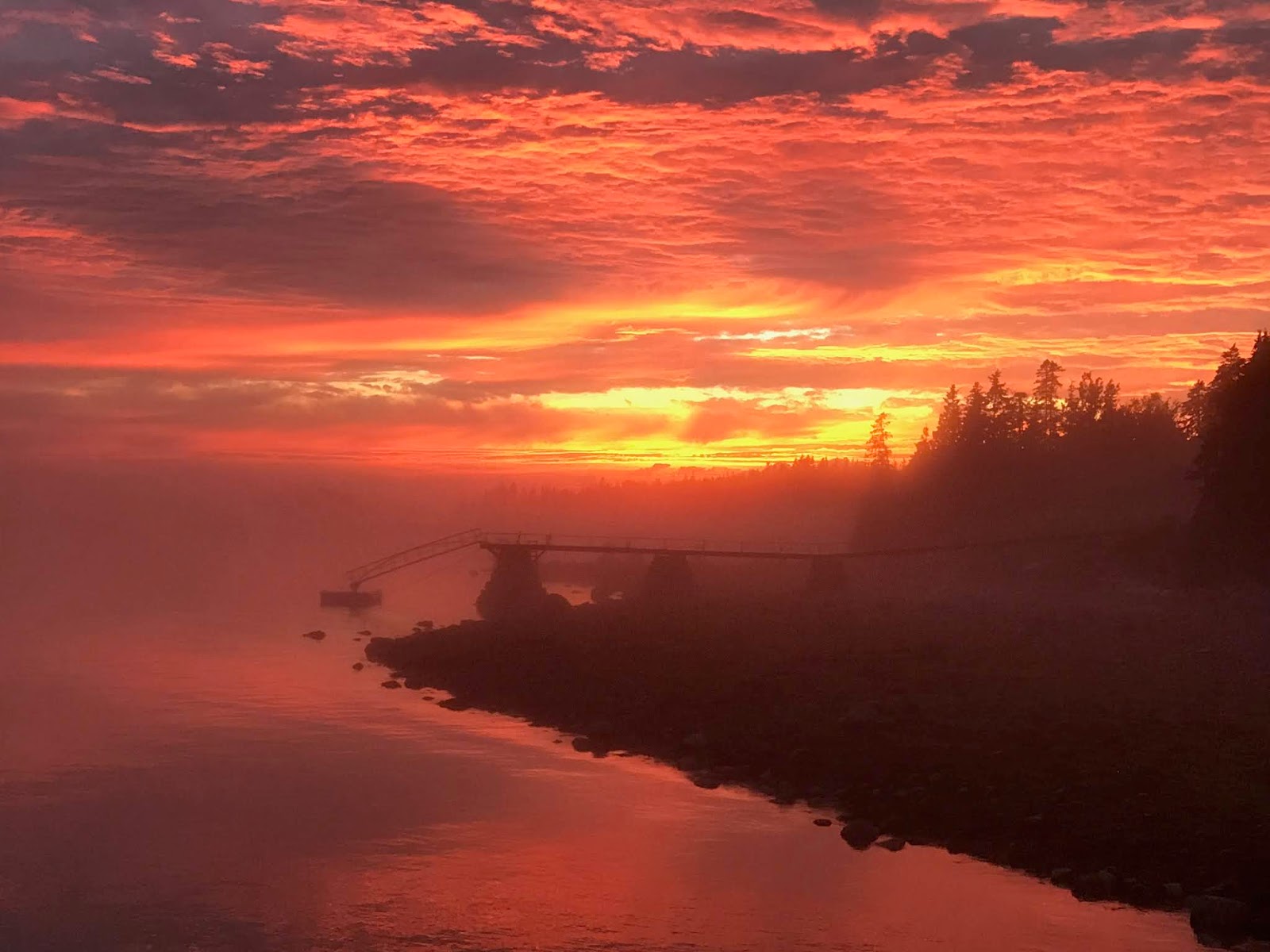
The Mary Day returns and we're for another visit. And a Maine sunset.


Mike had to get in on the action with his McKenzie.


Deck Framing


Spiling on the decking.


Things get a little slower at this point. Glassing deck joints, installing hinges and latches and so forth.
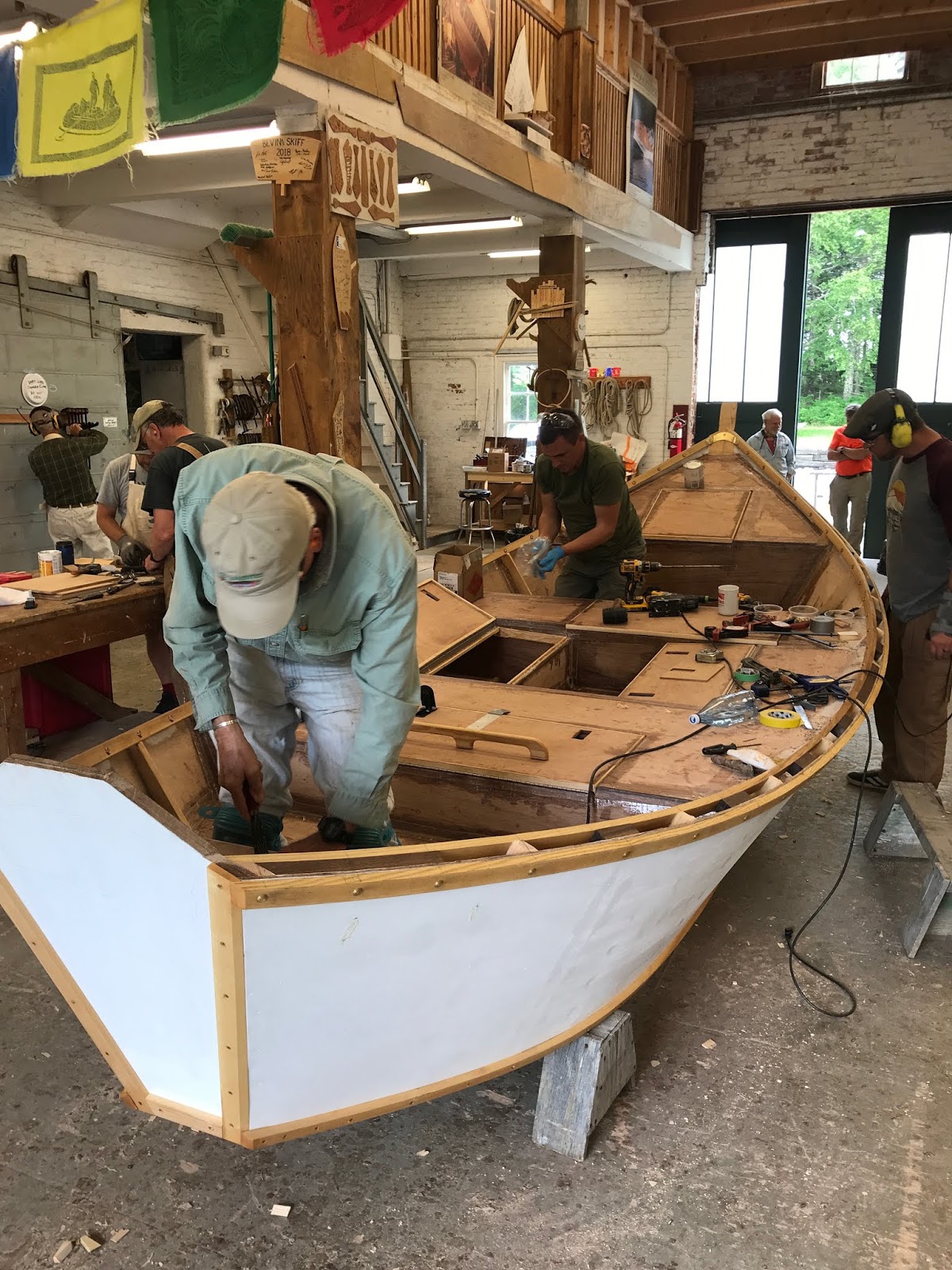

We did an evening shift and painted the decks. And what the hell, why not a red stripe?


Day ten. Raging into a finale. All hardware on.


We even quit a little early and headed down to the waterfront. We had planned to roll it, but it was cold and rainy. So we rolled it anyhow. Woot woot!


Will, second from right, won the lottery. He named her the Monongahela.


Monongahela is heading to Virginia.


Time to head south. Here is Sam Manning's dory. Sam, one of the great boat artists, illustrators, boatmen, a true gentleman, and maybe the world's greatest sculler, passed on a few days earlier. 


I stopped by the open house at the Lie-Nielsen tool factory and ran into Douglas Brooks, who will teach me the art of Japanese Boatbuilding in Port Townsend in August. We'll build one of these wacky boats.


Can't pass by the Lowell Boat Shop--the Mecca of dorydom.
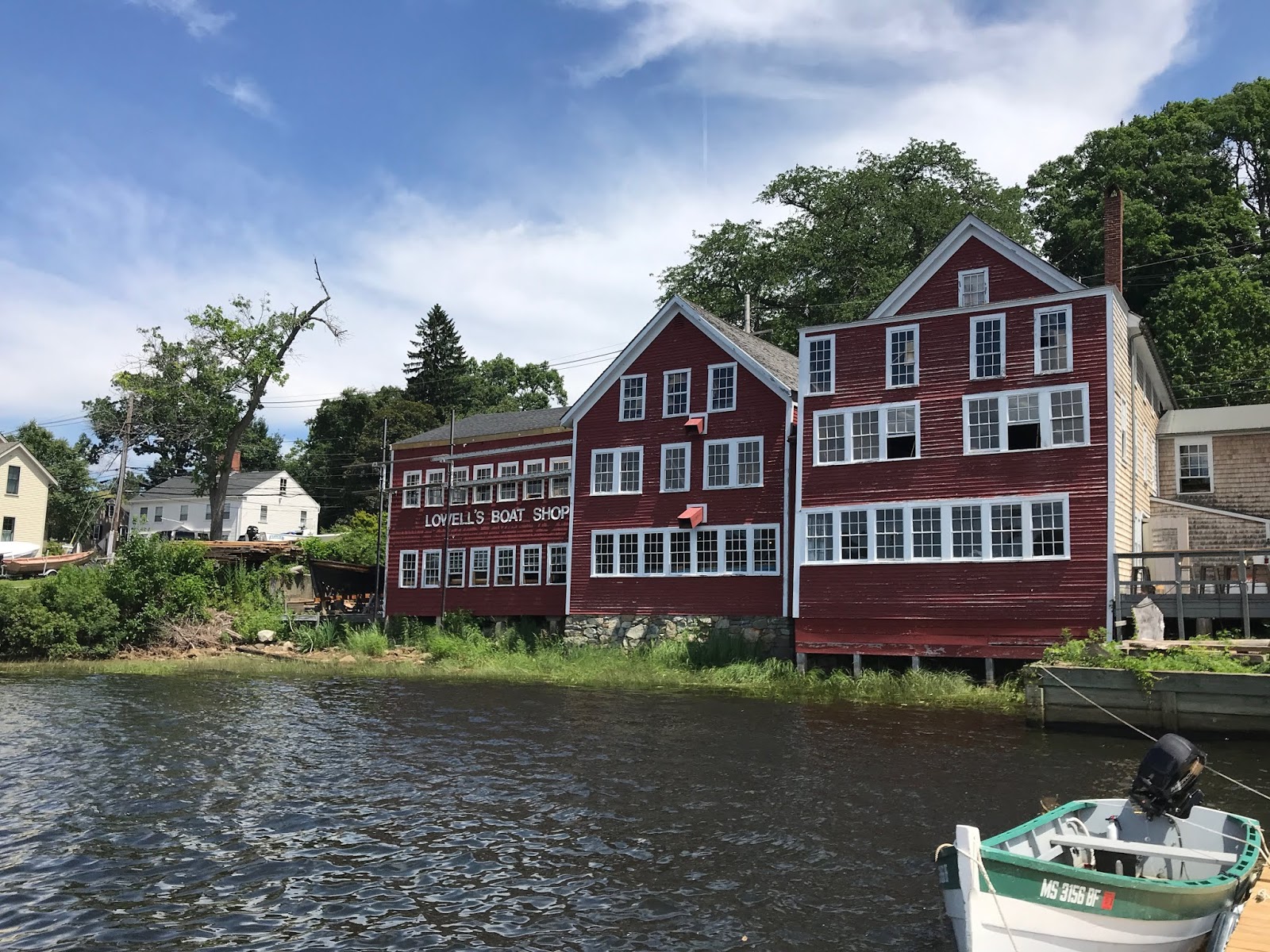

I had a nice chat with Graham Mackay, who directs the madness here.


And out to Gloucester to visit Geno Mondello at his dory shop.


His chaos makes me feel so at home.


I spend a couple nights at Jane and Bill's place in the south of Maine--fellow teachers and friends from WoodenBoat School. Jane is a great tour guide. A final visit to the Atlantic Ocean, then back to the desert.


Saturday, July 20, 2019

Milford Buchanan and the Shelburne Dory

Five years ago I stopped in at the Shelburne Museum Dory Shop in Nova Scotia. I met Milford Buchanan and we spent a few hours working on a dory. He builds a Shelburne style Banks Dory, which has subtle differences from the Lunenburg and Salisbury dories--the makers of each style quite certain that theirs is the one proper way to build them.


At the time, Milford had a couple helper/apprentices, but both were older than he, and neither were likely to carry on the process should Milford pass on someday. This year I decided to see if it would be okay for me to go back up and try and get a bit more of his story. Yes, was the response. Come on up.

Milford had a floor glued up and ready to go when I got there. We set in immediately, using the ancient wooden patterns to lay out the shape of the floor and cut out a great 15 foot long, 3 foot wide lozenge of 1" pine. We then used more old patterns to lay out rib parts, transom, stem, and circle board. 

We cut them on the old 1920s vintage Crescent Universal Wood Worker. It is belt driven with a venerable electric motor, and consists of a 32" band saw, a table saw, a jointer, a router-table, and hole borer (horizontal drill press)--the original Swiss army knife of stationary tools. Milford informed me that this was a new acquisition--that they didn't have that until the shop got electricity back in 1920. 


Here's a complete Shelburne dory.


And a nest of three. They were built to be nested five or six deep on the decks of schooners, sailed out to the Banks, and dropped overboard where teams of two could trawl for cod.


This boat was built by one of Milford's predecessors, Sidney Mahaney, who built dories here for over seventy years.


This is the cradle or "building horse" that has birthed something like 50,000 dories in its 130+ years.


A pattern for the "circle board", which goes near the top of the inner face of the transom.


Milford peening on the patented clips, invented here in Shelburne in the 1800s, that allowed them to build rib sections out of short straight pieces of oak rather than have to find natural grown oak or hackmatack tree roots to form the curve. This invention doubled production.


In the off season Milford is the king of Shelburne whirligigs--made in the shape of dorymen, lobsters, sailboats and so forth.


Once we got the "skillet" together--meaning the bottom, ribs, transom, and stem--it was time to begin planking her.


Checking the ribs and bottom for proper bevel, so the strakes won't leak.


Cotton candlewick, comprised of about five strands, gets tacked on before the strakes are attached to help seal the seam.


Cutting strakes on the Universal Wood Worker.


Mick, one of Milford's regular volunteers, got back to town a few days after I did. About ten years ago he visited the shop, volunteered to help, and ended up buying a home nearby.


Meself working on one of the bevels.


We got the garboards fit and fastened and were fitting the next strake when my clock ran out. There's a lot more to this story, but it looks like it may be a magazine article, so stay tuned.


Before I left we took one of the boats out for a spin. They scoot along pretty good, but like all dories, could use a bit of low ballast for stability.


On the way home I stopped to visit the Lunenburg Dory Shop, but no one was home.


Then time to catch the ferry back to the USA and teach a course building a Grand Canyon Dory. No rest for the wicked.